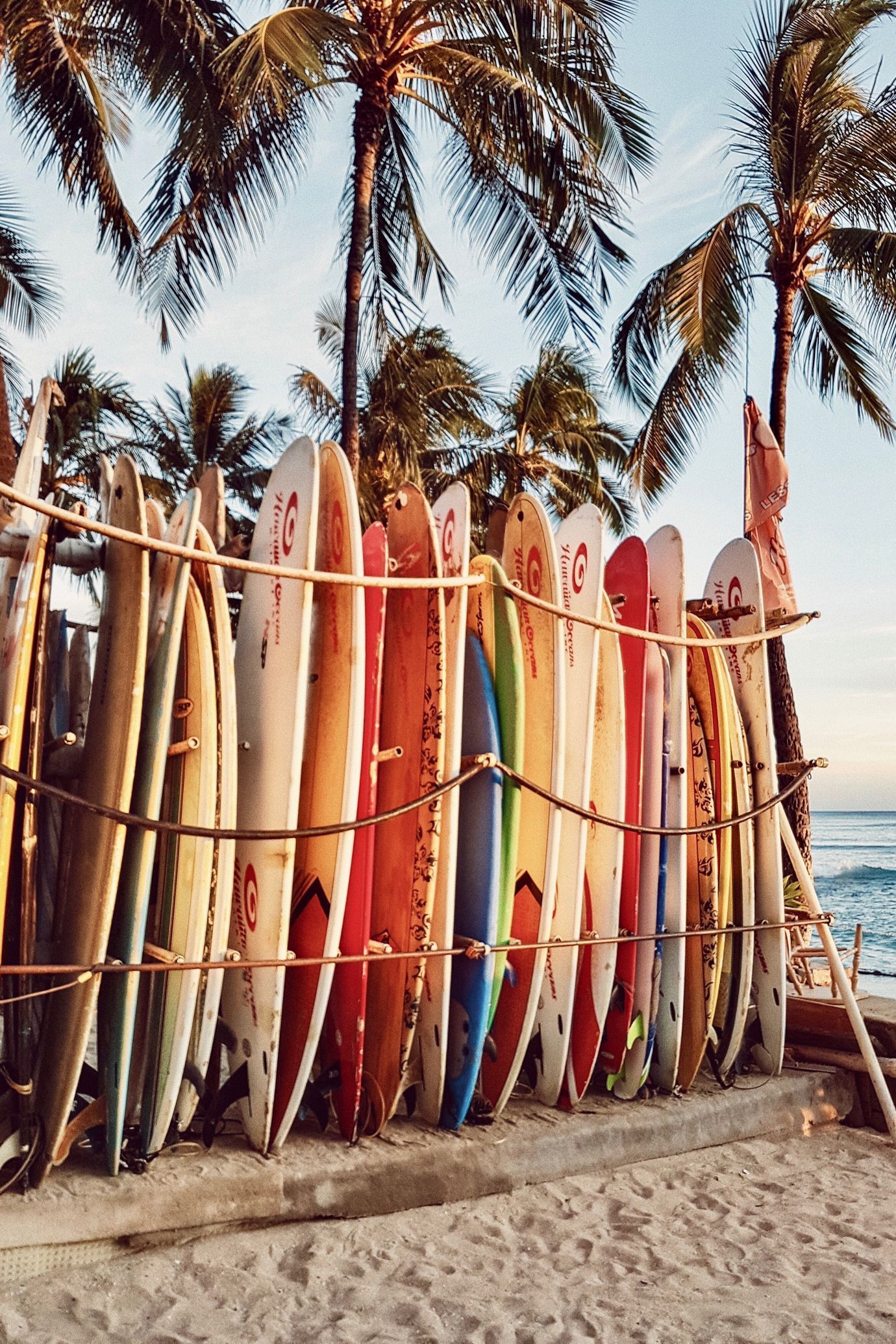
Walk into any surf shop and you will face a wall of boards in every shape and colour. For a beginner, the choice can feel overwhelming — and buying the wrong board is the most common reason people struggle to progress. This guide explains, in plain language, what actually matters when choosing your first surfboard as a woman.
Volume: the number that matters most
A surfboard's volume, measured in litres, tells you how much it floats. More volume means the board sits higher in the water, paddles faster, catches waves earlier and is more stable when you stand up. For beginners, volume is your best friend.
A simple rule of thumb is to multiply your body weight in kilograms by a factor based on your level:
| Level | Volume factor | Example for 60 kg |
|---|---|---|
| First sessions | 1.0 – 1.2 × body weight | 60 – 72 L |
| Catching whitewater consistently | 0.8 – 1.0 × | 48 – 60 L |
| Riding green waves, turning | 0.6 – 0.8 × | 36 – 48 L |
| Intermediate | 0.45 – 0.6 × | 27 – 36 L |
Add a little extra volume if you only surf occasionally, surf in weak or small waves, or wear a thick winter wetsuit.
The main types of beginner boards
Soft-top foam board (7'0" – 9'0")
The classic learner board. A foam deck, slick plastic bottom and lots of volume make it forgiving and safe. Modern soft-tops with wooden stringers and laminated bottoms perform surprisingly well — many experienced surfers keep one for small days. A shorter, wider soft-top such as our Midnight Soft-Top Fish is a fun second board once you are catching green waves.
Mini-mal (7'0" – 8'0")
A shorter version of a longboard with a rounded nose. Easier to carry and turn than a longboard, with enough volume to paddle well. A great "progression" board for your second year.
Longboard (9'0" and up)
Long, stable and graceful. Longboards catch waves very early and let you learn to walk the board, cross-step and noseride. If you are drawn to the stylish, flowing side of surfing, a longboard may be your forever board. Our Timber Classic 9'1" is designed to take you from your first green waves to your first noseride.
Funboard / egg (6'6" – 7'6")
Rounded outlines with generous volume. Versatile and easy to turn, but less stable than a mini-mal for complete beginners.
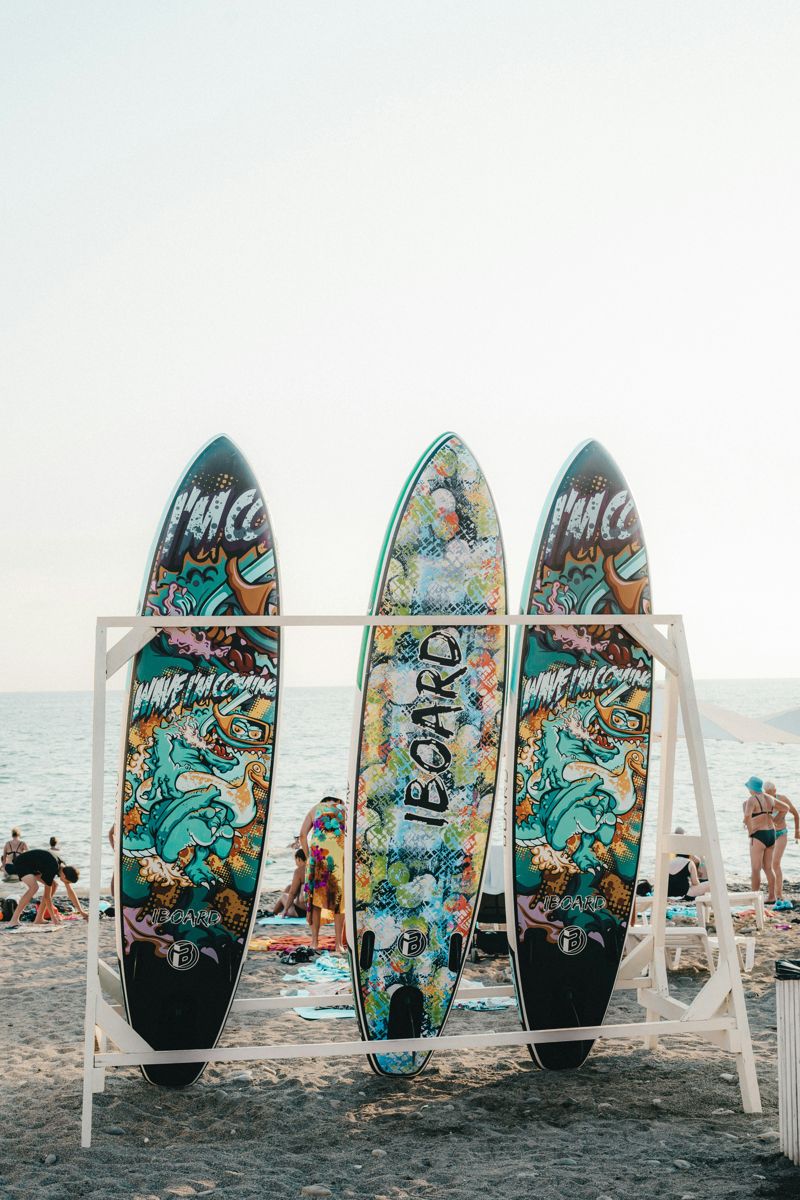
Soft-top or hard board?
For your first months, a soft-top wins almost every time: it is cheaper, safer and tougher. Hard boards (epoxy or polyester) become interesting when you want more speed, response and a board that holds its value. Epoxy boards are lighter and more durable than traditional polyester boards, which is useful when you carry your board on your own or travel with it.
Length, width and thickness
- Length helps with paddling speed and stability in a straight line. Longer is easier to catch waves on, harder to turn and carry.
- Width (measured at the widest point) is the key to stability side-to-side. Look for 21" – 23" as a beginner.
- Thickness adds volume. Thick rails float more but feel "corky" when you try to turn.
Women are often told to choose a smaller board "because you are lighter". Be careful: lower body weight does mean you need less volume, but you still need enough length and width for stability. Do not size down too fast.
Fins, leash and wax
Beginner boards usually come with a thruster (three fins) or a 2+1 setup. Soft, flexible fins are safer when learning. Your leash should be about as long as your board — a 9' leash for a 9' longboard — and attached to your back ankle. Finally, a hard board needs wax for grip; soft-tops benefit from wax too. Choose a formula for your water temperature, like our Softboard Wax Duo.
Carrying a big board on your own
Long boards can be awkward, especially in wind. These tricks help:
- Carry it on your head, deck down, with both hands on the rails — a classic technique for longboards.
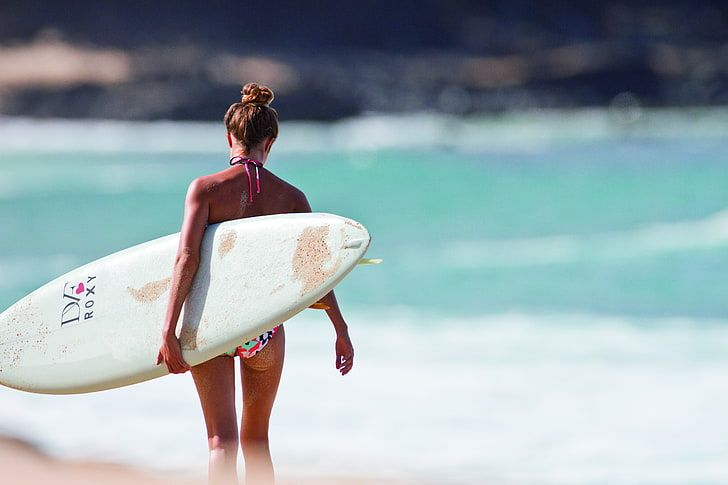
- Or tuck it under your arm with the nose pointing slightly into the wind so gusts do not twist it.
- Use a padded board sling or shoulder strap for long walks to the beach.
- Choose epoxy construction: a 9' epoxy board can be one or two kilos lighter than its polyester equivalent.
New or second-hand?
A good second-hand board can be a smart buy. Check for yellowing (a sign of water damage), soft spots on the deck, cracks around the fin boxes and dings that have not been sealed. Press the deck with your thumb — it should feel solid. If you buy new, you get a warranty and a board built for your exact needs.
Storage and care
- Keep your board out of the sun when you are not surfing — heat can cause delamination.
- Store it in a padded board bag, horizontally on a rack or vertically on its tail with padding.
- Rinse with fresh water after each session and let it dry before putting it in the bag.
- Never leave a board on a hot car roof or in a closed car in summer.
- Repair dings quickly so water cannot soak into the foam core.
Our recommendation
Start on a big, wide soft-top of 8'0" to 9'0". When you are catching green waves on your own, choose between a mini-mal (if you love turning) and a longboard (if you love gliding). Keep your first soft-top for small days and for friends who want to try — you will be surprised how often you use it.
Frequently asked questions
Most women start on a board between 8'0" and 9'0" with 55–75 litres of volume. Lighter surfers can go a little shorter; taller or heavier surfers, or anyone surfing weak waves, benefit from more volume.
Yes — soft-tops are the best boards to learn on. They float well, are stable and the soft deck makes collisions far less painful.
When you can consistently catch unbroken waves on your own, stand up quickly and ride along the face in both directions. Drop length gradually, not all at once.
Epoxy boards are lighter, more buoyant and more ding-resistant, which makes them great for beginners and travel. Polyester (PU) boards have a classic feel and flex that many experienced surfers love.